

Group website:
Other company websites:
Choose website








School Bag Screening Systems: Building Faster, Smarter Security Checkpoints for U.S. Schools



13 October 2026
School Bag Screening Systems: Building Faster, Smarter Security Checkpoints for U.S. Schools
Discover how AI-powered X-ray bag screening can help U.S. schools build faster, more efficient security checkpoints. Learn how LINEV Systems solutions support backpack screening, weapons and vape detection, high student throughput, and integration with existing campus security measures.
A school bag screening system gives security teams a practical way to inspect backpacks, handbags and personal belongings before they move beyond the entrance — without opening every bag or turning the morning arrival period into an airport-style checkpoint.
For U.S. school districts, the operational challenge is not simply detecting a prohibited item. A screening checkpoint also has to process hundreds or thousands of students in a short arrival window, fit into existing entrances, support consistent security procedures and remain manageable for school staff day after day.
Modern X-ray baggage scanners combine detailed X-ray imaging with AI-assisted threat detection to help schools inspect backpacks for firearms, firearm components, knives, ammunition, vaping devices and other prohibited items. The result is a security layer built around the bag itself rather than repeated manual searches.
What Makes a School Security Checkpoint Different?
A school entrance operates differently from an airport or government facility. Most students arrive within a concentrated period before classes begin. Backpacks are often densely packed with laptops, books, water bottles, chargers, sports equipment and personal items. At the same time, the school cannot allow security procedures to create excessive queues outside the building.
That makes checkpoint design just as important as the scanner itself. A practical school screening system should address four questions from the beginning:
- How many bags must be screened during the peak arrival period?
- What types and sizes of bags normally enter the building?
- How will students move from screening to access-controlled areas?
- What happens when the system identifies a possible prohibited item?
Answering these questions before equipment is selected helps a district choose the correct combination of throughput, tunnel size, staffing and checkpoint layout.
How X-Ray School Bag Screening Works
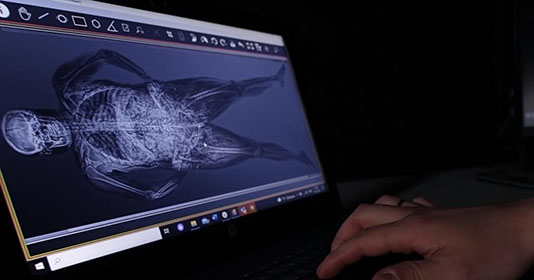
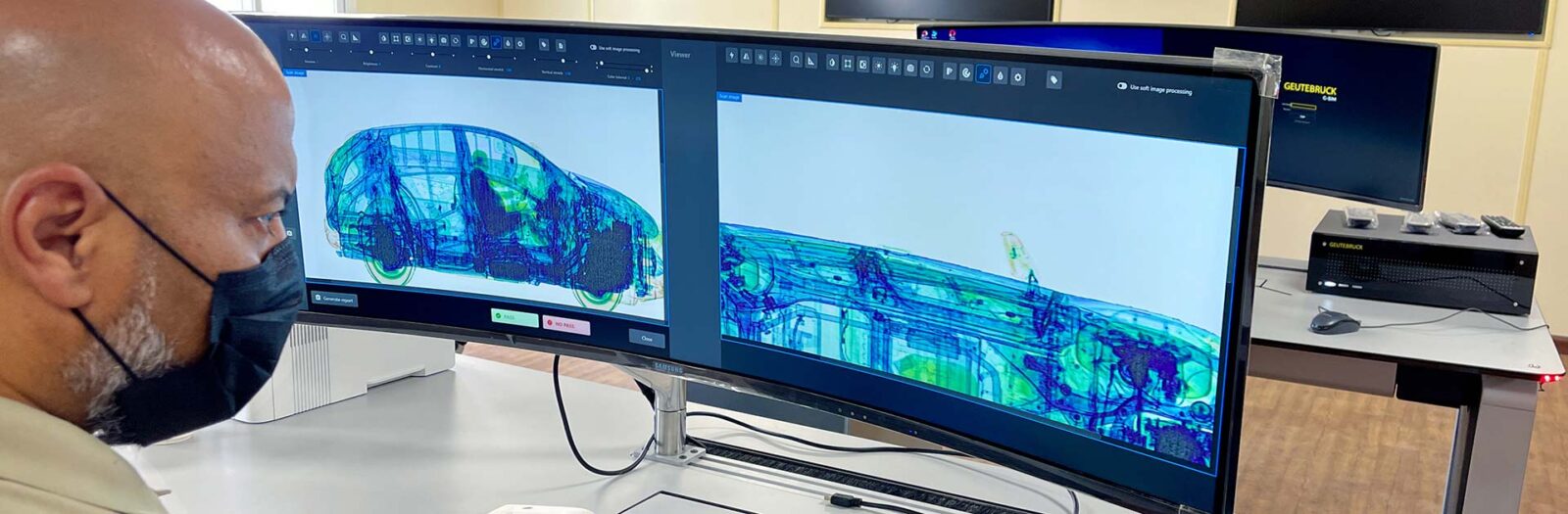
Unlike a walk-through metal detector, an X-ray bag scanner examines the contents of a backpack or personal bag. Different materials absorb X-rays differently, allowing the system to create an image that reveals the internal structure and composition of the items inside.
This matters in a school environment because not every security concern is a large metallic object. A firearm may be partially disassembled. A knife may be positioned among books and electronics. A vape or other prohibited device may be concealed beneath ordinary personal belongings.
LINEV Systems combines X-ray imaging with A-EYE™ automated threat detection. The software analyses the X-ray data and can identify categories including firearms, firearm components, ammunition, knives, grenades, brass knuckles and vaping devices.
When a potential threat is identified, the object can be highlighted on the screen and the conveyor can be stopped so trained personnel can follow the school’s established response procedure.
High-Volume Entrances: LV STREAM
For a main entrance where large numbers of students arrive within a narrow time window, throughput becomes a major part of the security design.
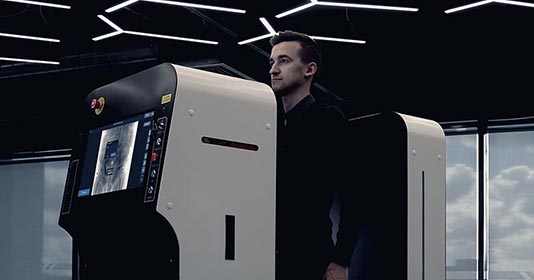
LV STREAM is designed as a high-throughput AI-powered bag-screening gateway. It combines dual-view X-ray imaging, automatic scanning and A-EYE™ detection to reduce how much routine screening depends on continuous manual image interpretation.
Key capabilities for school entrance screening include:
- Up to 1,400 bags per hour. High throughput helps schools handle concentrated morning arrival periods without creating unnecessary bottlenecks.
- Dual-view X-ray imaging. Two perspectives of the same bag improve visibility when objects overlap or are positioned at difficult angles.
- AI-assisted threat detection. A-EYE™ analyses the X-ray data for known threat and prohibited-item categories.
- Automatic scanning. Screening begins as the bag moves into the inspection tunnel.
- Reduced dependence on continuous image review. Automated analysis allows the checkpoint team to focus more attention on exceptions and response procedures.
- Flexible deployment. The system can support entrance layouts where fast bag flow is a primary operational requirement.
Flexible School Checkpoints: The BV Scanner Line
Not every school entrance requires the same architecture. A main student entrance may experience a sharp morning surge, while a visitor entrance, athletic facility, administrative building or secondary access point may see a smaller and more consistent flow.
The LINEV BV range provides multiple tunnel sizes and configurations for bag and parcel inspection. Compact systems such as the BV 5030 are particularly relevant where backpacks and smaller personal belongings make up most of the screening volume.
Larger tunnel configurations can support locations where sports bags, musical equipment, deliveries or larger items also need to be inspected.
| Checkpoint Requirement | LV STREAM | BV Line |
| Typical application | High-volume student entrance | Student, visitor, staff or secondary checkpoint |
| Screening approach | High-throughput automated AI screening | Traditional tunnel inspection with AI assistance |
| Bag flow | Designed for concentrated peak periods | Flexible for steady or moderate screening volumes |
| Tunnel configuration | Purpose-built high-flow configuration | Multiple tunnel sizes available |
| Best fit | Main entrances and large arrival waves | Entrances requiring a specific footprint or item capacity |
AI Detection for Weapons, Vapes and Prohibited Items
The value of AI in a school security checkpoint is not simply that it adds another feature to an X-ray machine. Its role is to make threat identification more consistent when screening volume is high and bags contain many overlapping objects.
A-EYE™ was developed using real threat objects presented against varied baggage backgrounds. Instead of expecting a staff member to identify every suspicious shape unaided, the system can highlight objects that match known threat categories.
For schools, vape detection is particularly relevant. E-cigarettes and vaping devices are small, easy to conceal and can be difficult to find through routine visual checks. Automated identification gives school personnel another tool for enforcing campus prohibited-item policies without opening every backpack.
Smart Zoom for Complex Backpack Images
Dense backpacks can contain electronics, chargers, books, bottles and other objects positioned on top of one another. LINEV Smart Zoom technology uses machine-learning-based image processing to enhance detail in the original X-ray image and can magnify the image up to 96 times.
Smart Zoom enhances information captured during the scan; it does not create information that was absent from the original X-ray data. Its purpose is to help make existing image detail easier to evaluate.
How to Design a School Bag-Screening Checkpoint
A successful school screening program should be designed around student movement rather than simply placing a scanner at the door.
1. Measure the Peak Arrival Window
Daily enrollment alone does not determine scanner capacity. The more useful measurement is how many students arrive during the busiest 10, 20 or 30 minutes. Bus schedules, parent drop-off patterns and multiple building entrances can dramatically change the required screening capacity.
2. Identify What Students Actually Carry
Most academic backpacks may fit a compact tunnel, but sports teams, band programs and extracurricular activities can introduce much larger bags. Understanding the normal item profile helps prevent unnecessary exceptions and rescanning.
3. Separate Screening From Resolution
The main flow should continue whenever possible. When a bag is flagged, a secondary inspection area allows trained personnel to resolve the alert without stopping every student behind it.
4. Connect the Checkpoint to Existing Security
X-ray bag screening is most useful as one layer of a wider school security plan. Access control, visitor management, video surveillance, trained personnel and emergency procedures should work together rather than as isolated systems.
5. Define the Response Procedure Before Launch
Technology identifies or highlights a potential item. School personnel remain responsible for following district policy and the appropriate response protocol. Those procedures should be established before the first day of screening.
What Real U.S. School Deployments Can Teach Districts
School districts do not have to evaluate X-ray backpack screening only as a theoretical concept. LINEV Systems technology is already being used in U.S. educational environments.
At Schenectady High School in New York, the district deployed BV 5030 backpack scanners after evaluating multiple weapons-detection approaches. The district later reported operational experience involving weapon interception, student throughput and integration of screening into the school day. Read the Schenectady High School weapons detection case study.
Albany City School District has also implemented BV 5030 scanners with A-EYE® AI and vape detection as part of its campus safety strategy. See the Albany City School District deployment.
These deployments are useful for other districts because they show that the practical questions — student throughput, staffing, training, checkpoint location and community acceptance — are as important as technical detection capability.
Privacy and Communication With Students and Families
Bag-screening technology should be explained clearly before it becomes part of the school day. Students and families should understand what is being screened, what happens when an item is flagged and how staff will respond.
X-ray backpack scanners inspect belongings rather than exposing students to an X-ray beam. The X-ray inspection takes place inside the enclosed scanner tunnel while the student remains outside the system.
Clear signage, trained staff and a predictable screening procedure can help make the checkpoint feel like a normal part of entering the building rather than a disruptive daily event.
Managing Multiple School Screening Systems
For districts operating scanners across several schools, equipment management becomes another consideration. X-LINEView provides telemetry and preventive-maintenance capabilities for monitoring scanner performance.
Capabilities include monitoring of operating parameters, failure notifications, usage analysis and remote visibility into system performance. For a district, this can make a group of scanners easier to manage as one screening infrastructure rather than as unrelated pieces of equipment.
Choosing the Right School Bag Screening System
The right system is determined by the checkpoint, not simply by the largest specification on a product sheet.
A high school processing a large bus arrival may benefit from a high-throughput LV STREAM configuration. A smaller school, visitor entrance or secondary access point may be better served by a compact BV scanner. A district operating multiple buildings may ultimately use both approaches.
The goal is the same in each case: inspect bags consistently, identify prohibited items before they move deeper into the building and maintain a screening process that the school can realistically operate every day.
FAQ: School Bag Screening Systems
What is a school bag screening system?
A school bag screening system uses security technology such as an X-ray scanner to inspect backpacks, handbags and other personal belongings at an entrance. X-ray imaging allows security personnel or AI detection software to evaluate the contents without opening every bag.
Can an X-ray school backpack scanner detect weapons?
Yes. X-ray imaging can reveal firearms, firearm components, knives, ammunition and other dense or concealed objects. LINEV Systems scanners can also use A-EYE™ AI to automatically identify supported threat categories.
Can school X-ray scanners detect vapes?
LINEV A-EYE™ threat-detection software includes vape detection designed to identify e-cigarettes and vaping devices concealed in baggage or personal belongings.
Do students go through the X-ray scanner?
No. A baggage X-ray system scans the bag inside an enclosed inspection tunnel. Students remain outside the X-ray inspection area.
Should schools use X-ray scanners instead of metal detectors?
The technologies perform different functions and can be complementary. A walk-through detector screens the person for metallic objects, while an X-ray baggage scanner examines the contents of backpacks and other belongings.
Which X-ray scanner is best for a school entrance?
The answer depends on peak student volume, bag sizes, available entrance space, staffing and the school’s response procedure. High-volume entrances may require a system optimized for rapid flow, while smaller or secondary checkpoints can use compact tunnel scanners.
Building a School Checkpoint Around the Real Operational Need
Effective school screening is not about adding the most intimidating security equipment to an entrance. It is about matching detection technology to the way students, staff and visitors actually move through the building.
By combining AI-assisted X-ray bag screening with appropriate access control, trained personnel and a clearly defined response process, schools can create a checkpoint that strengthens security while preserving the rhythm of the school day.

Manage Consent
Functional Always active
The technical storage or access is strictly necessary for the legitimate purpose of enabling the use of a specific service explicitly requested by the subscriber or user, or for the sole purpose of carrying out the transmission of a communication over an electronic communications network.
Preferences
The technical storage or access is necessary for the legitimate purpose of storing preferences that are not requested by the subscriber or user.
Statistics
The technical storage or access that is used exclusively for statistical purposes. The technical storage or access that is used exclusively for anonymous statistical purposes. Without a subpoena, voluntary compliance on the part of your Internet Service Provider, or additional records from a third party, information stored or retrieved for this purpose alone cannot usually be used to identify you.
Marketing
The technical storage or access is required to create user profiles to send advertising, or to track the user on a website or across several websites for similar marketing purposes.